
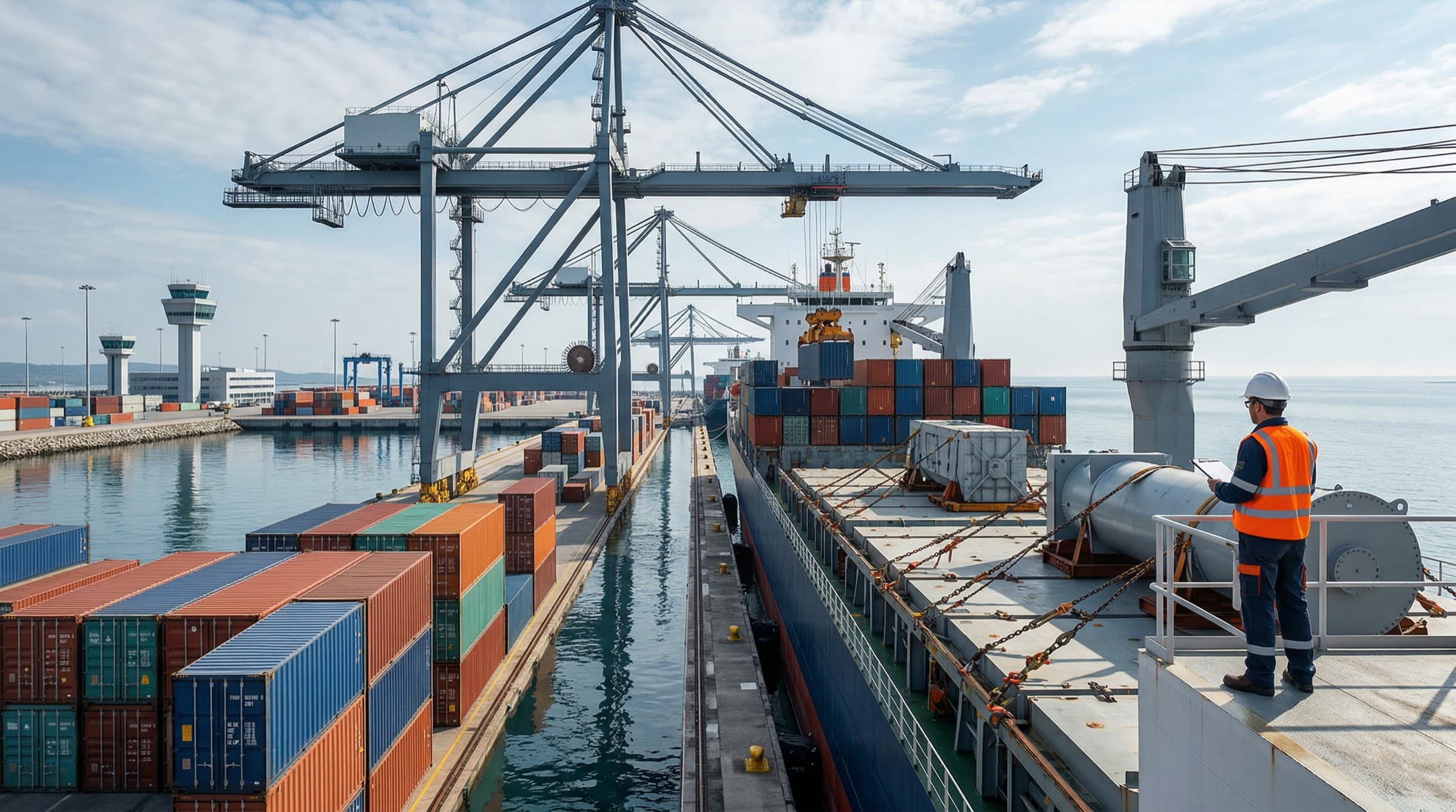
On a project cargo shipment, the supercargo attends on behalf of the cargo owner to follow how heavy and out-of-gauge units are lifted, stowed and secured against the agreed lift plan and lashing instructions. Because a single unit can be extremely valuable and hard to replace, the supercargo's job is to spot risks early, report them at once and document every stage.
What is project cargo and why does it need special attention?
Project cargo covers equipment destined for an investment project: power plant components, transformers, tanks, turbine sections, industrial machinery or prefabricated modules. Units are typically heavy, out of gauge and lifted one by one, each with its own stowage and securing arrangement.
Damage to one piece does not just mean a repair bill; it can delay a whole project for months. That is why cargo owners and project forwarders often appoint a supercargo to watch the operation on their behalf.
Project moves are usually one link in a long chain involving the manufacturer, road haulier, port, vessel and project site. The cargo changes hands at every link, and each handover is a moment when responsibility may change hands too. The supercargo records the port end of that chain.
What does the supercargo review before operations?
With project cargo, preparation matters as much as execution. Before the units reach the quay, the supercargo studies the technical documents and checks that site conditions match them.
The main documents and points reviewed are these.
- Packing list with dimensions and weights
- Drawings showing centre of gravity and lifting points
- Lift plan, cranes, slings and spreader beams to be used
- Permissible deck and tank top loads
- Stowage and lashing plan
- Quay storage area and handover from road transport
What is watched during lifting?
Safety of the lift is the responsibility of the vessel, the terminal or the lifting contractor. The supercargo observes whether the cargo owner's instructions and the manufacturer's marked lifting points are respected.
Use of the wrong lifting points, slings bearing on sensitive surfaces, lifts attempted in unsuitable wind or units landed with sudden movements are all matters to raise immediately. Each lift is photographed before and after, building a clear record of the unit's condition.
How are stowage and lashing followed?
Once landed, a unit has to be secured to withstand the ship's motions at sea. The Cargo Securing Manual that ships carry under SOLAS and the IMO Code of Safe Practice for Cargo Stowage and Securing are among the main references here.
The supercargo observes whether the equipment specified in the lashing plan is used, whether chains and tensioners are applied without damaging the cargo and whether dunnage spreads the load as intended. The technical adequacy of the securing remains a matter for the master and, where engaged, lashing specialists.
What happens if damage or a deviation is found?
Whether a unit arrived at the terminal already damaged or was damaged during handling often decides later insurance and liability questions. The supercargo therefore records the unit's condition on arrival at the quay, immediately before lifting and in its final position on board.
Any damage is reported to the principal straight away. Decisions such as calling in an independent surveyor, issuing a letter of protest or notifying insurers rest with the cargo owner.
Damage notes should describe location, size and appearance without speculation, with measurements where possible. Close-up and overview photographs taken with a reference object help a remote insurer or surveyor understand the situation correctly.
How are quay storage and road handover monitored?
Project units often reach the port on special trailers, sometimes at night and on a schedule tied to road permits. Unloading them from the trailer and storing them on the quay can be as risky as the sea lift itself, because different equipment and different crews handle the cargo at this stage.
The supercargo observes the unit's condition before it leaves the trailer, the suitability of the storage area, whether the unit sits correctly on its cribbing and whether it is protected from the weather. A tear in packaging or covers spotted at this point can often be fixed with a simple intervention.
Key points during handover include:
- Condition of road lashings before release
- Correct use of unloading equipment and lifting points
- Ground bearing capacity and level of the storage area
- Protection against rain, dust and sea spray
- Observations and photos recorded on the handover note
What should you consider when appointing a project cargo supercargo?
On project shipments the supercargo's remit varies widely with the cargo and the contract of carriage. Agree at the outset whether the job covers port operations only, or also the handover from road transport and riding the vessel during the voyage.
Sharing drawings and lift plans well before the operation lets the supercargo arrive prepared. Karan Gözetim provides supercargo services for project cargo from Gemlik, with the scope agreed at the quotation stage.
Frequently asked questions
Does the supercargo approve the lift plan?
Generally not. The lift plan is a technical document agreed between its author, the vessel and the terminal. The supercargo checks that it is consistent with the cargo owner's instructions and reports observations.
Is out-of-gauge cargo carried on deck?
Depending on its dimensions, it may be stowed under deck or on deck. Deck carriage exposes the cargo to sea and weather, so it calls for extra protection and securing, and should be reflected in the contract and on the bill of lading.
What information should be shared in advance for project cargo?
Dimensions and weights, centre of gravity, lifting points, packing and protection details, sensitive surfaces and any special handling instructions. The earlier this arrives, the sounder the planning will be.
Topics
- project cargo supercargo
- project cargo shipment
- heavy lift cargo
- out of gauge cargo
- heavy lift loading supervision
- breakbulk project cargo